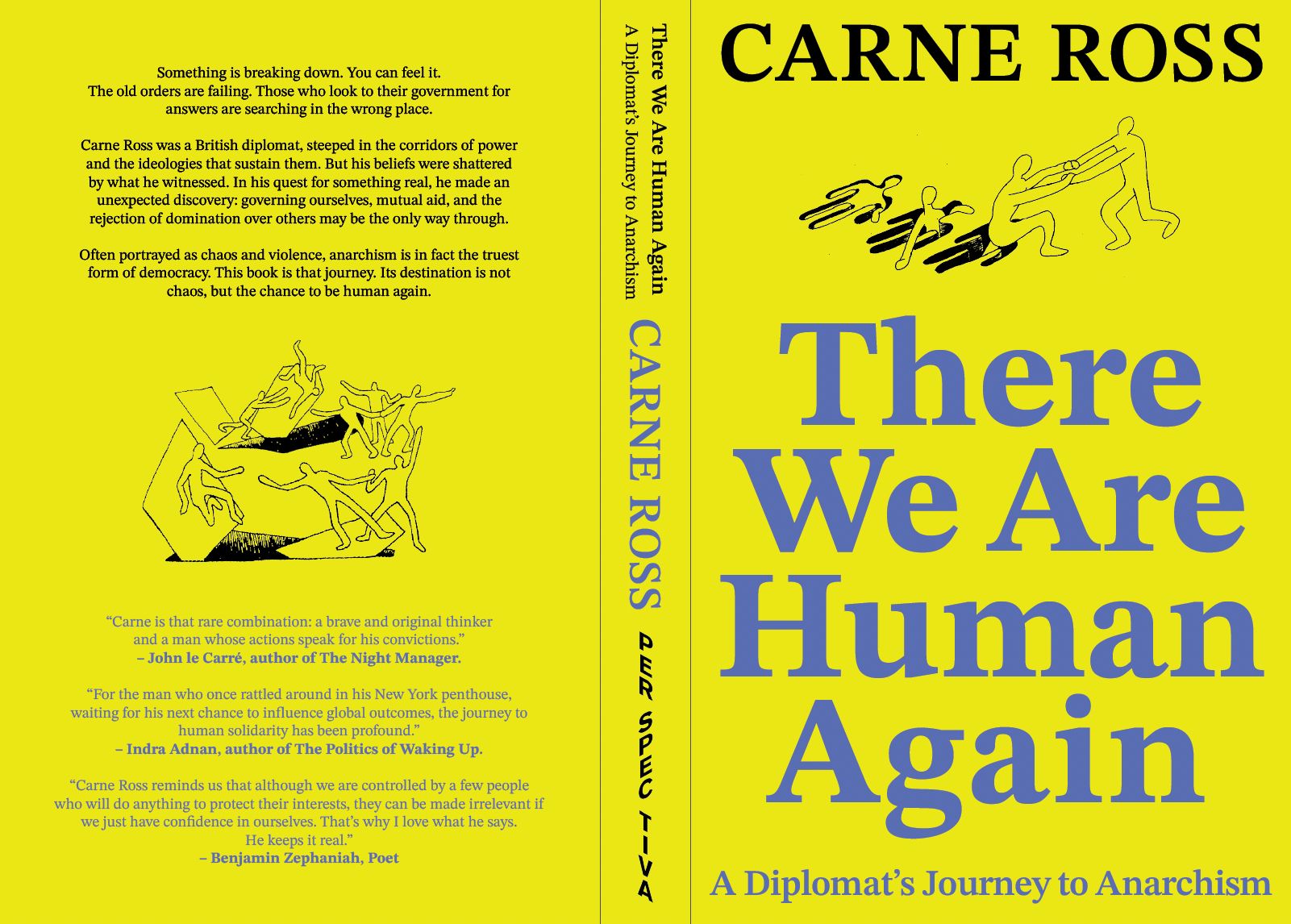
"Something is breaking down. You can feel it.
The old orders are failing. Those who look to their government for answers are searching in the wrong place."
"There we are human again: a diplomat's journey to anarchism"
perspectiva press, publication UK 9 June, US 11 July, 2026
The remarkable story of how a senior British diplomat lost his belief in the state and 'the system' and began a journey of personal and political discovery, until he eventually found a new and unexpected philosophy, of autonomy, mutual aid and rejection of hierarchy. A story of painful disillusionment and grief, and the search for something real. A story that tells a lot about the current crises and how they might be put right.
"It’s a brilliantly written book, written with verve and style and deeper levels of honesty than I’ve ever read in a political book. It feels like a gift to the world." (Reader review)
Buy
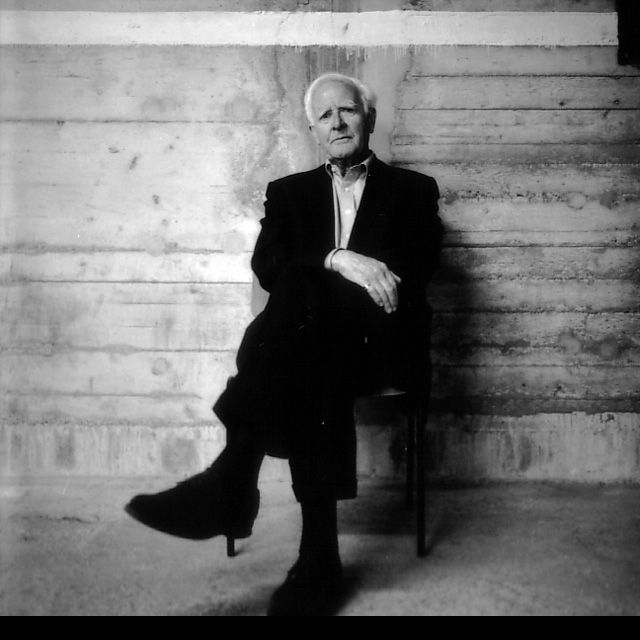
john le carrÉ
"Carne is that rare combination: a brave and original thinker, and a man whose actions speak for his convictions."
- JOHN LE CARRÉ, author of The Night Manager
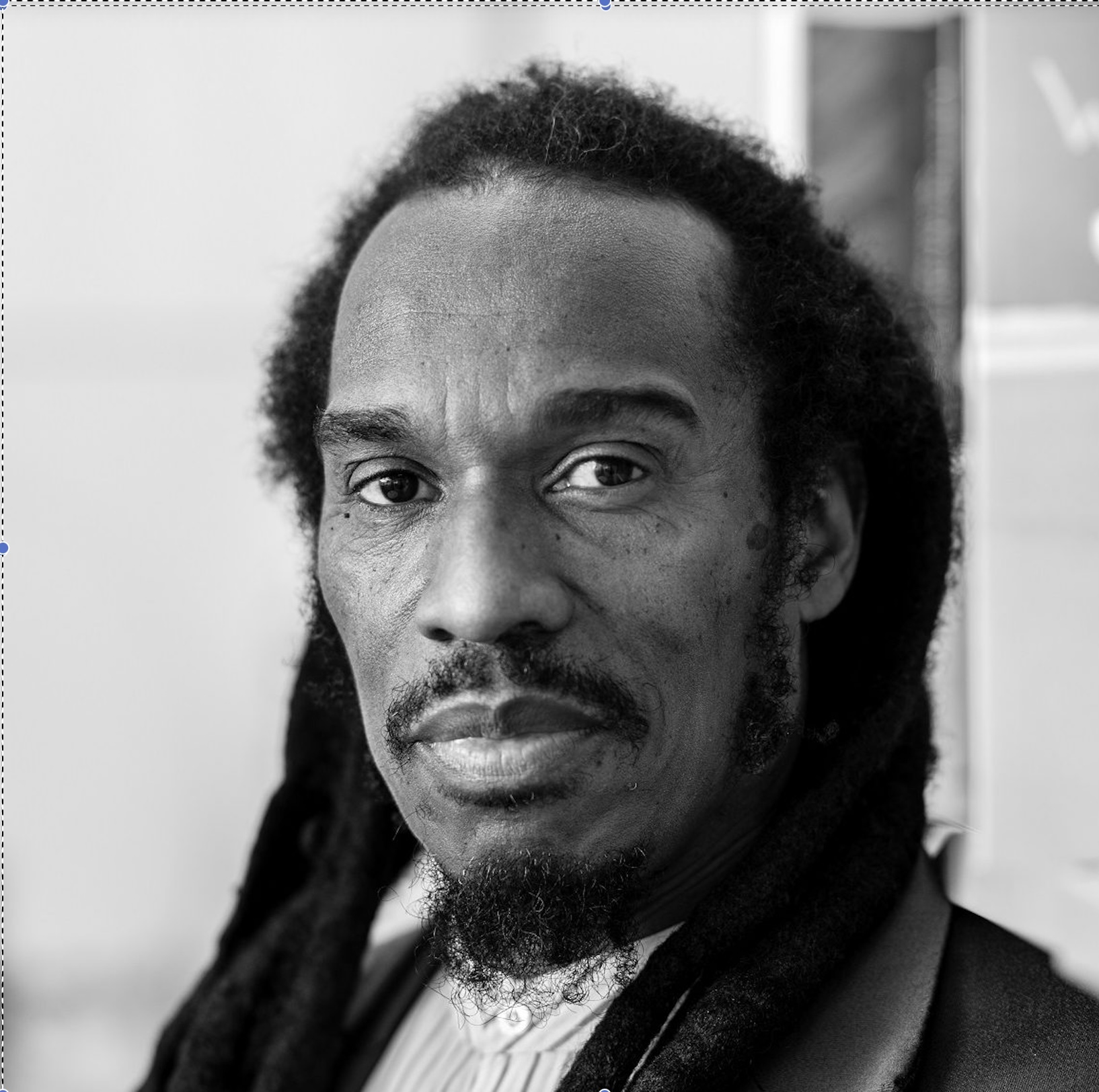
benjamin zephaniah
"Carne Ross reminds us that although we are controlled by a few people who will do anything to protect their interests, they can be made irrelevant if we just have confidence in ourselves. That's why I love what he says. He keeps it real."
- BENJAMIN ZEPHANIAH, Poet
indra adnan
"For the man who once rattled around in his New York penthouse, waiting for his next chance to influence global outcomes, the journey to human solidarity has been profound."
- INDRA ADNAN, author of The Politics of Waking Up
An early reader review from Amazon:
5 ⭐️
"It’s a brilliantly written book, written with verve and style and deeper levels of honesty than I’ve ever read in a political book. It feels like a gift to the world."
I’ve read a fair amount of politics books over my life (I studied it at university for a start) and I remember Carne’s first book, “Independent Diplomat”, as one of the best I’ve ever read. Well this book is also extraordinary: it’s intensely personal, a brave, brave attempt to reconcile the many different facets of his life. Carne was originally a British diplomat, working on the Iraq desk at the UN, and resigned because of the disinformation surrounding the decision to go to war in 2003. He speaks with great honesty about the thrill at being at the centres of power, and at great historical moments, and about his subsequent career… but also about what’s missing from virtually all political discourse, namely love: for Carne (and all of us I think) human connection creates the deepest feelings we can experience. What he then does is to attempt to marry the world of politics and organisation with love and connection itself. It leads him to anarchism, a theory of how small groups, working together with almost no hierarchy, can create a more meaningful, more liveable world.
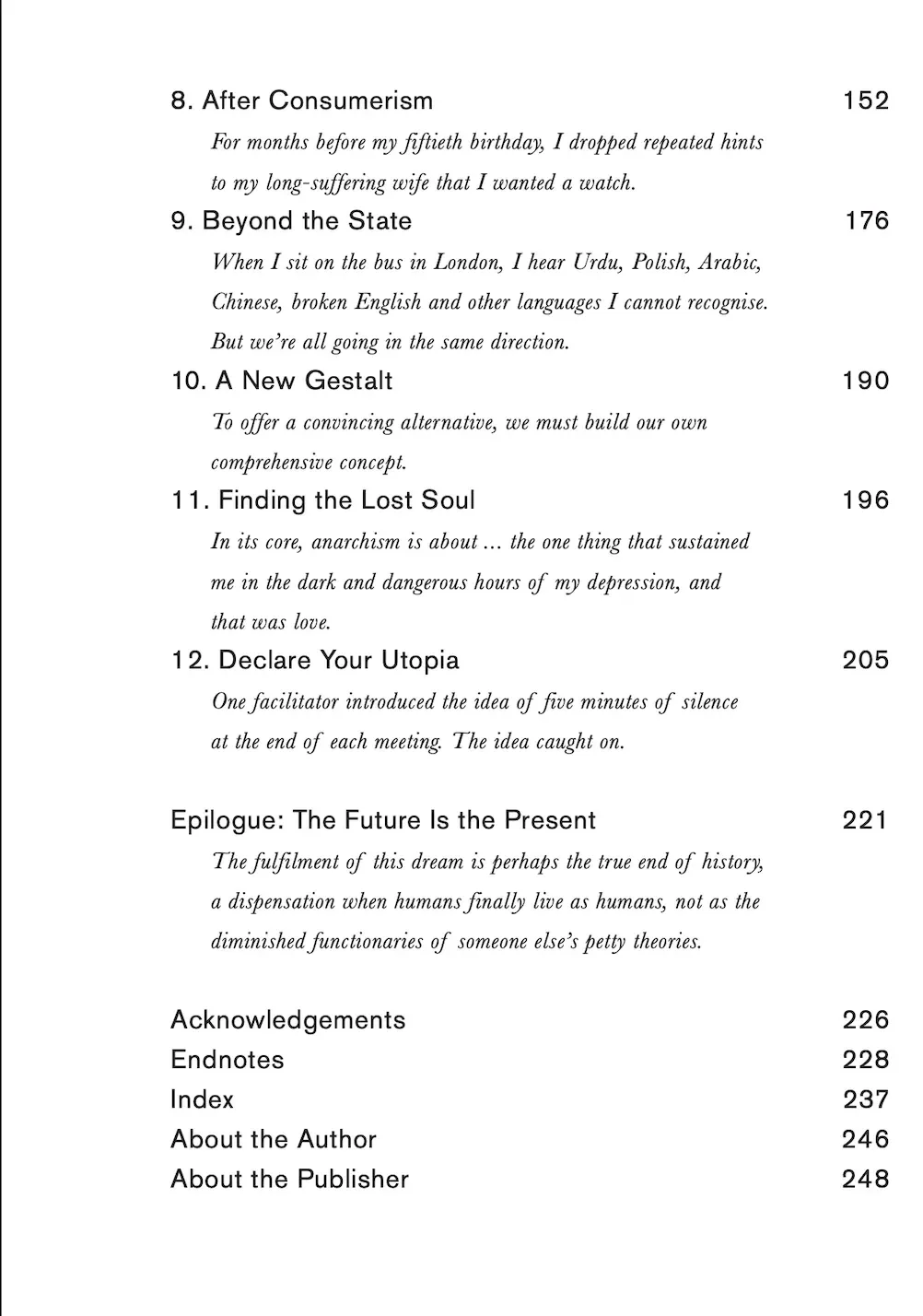
It’s a brilliantly written book, written with verve and style and deeper levels of honesty than I’ve ever read in a political book. It feels like a gift to the world. I’m still not persuaded by anarchism, but his final chapter, “Declare your utopia”, where he imagines how big things can build simply from a community working together after a flood, did feel inspired. There are good people, all around the world, helping others, in the best ways they know, and this book gives those efforts a context and a theory, forcing us to look at those efforts in a very different way.
It’s a great read from a man who is both political and human, to his fingertips." (RRC)
Carne wrote an essay about why he wrote the book. You can find it on his substack and here.
For news about publication and book events, please sign up here.
The publisher Jonathan Rowson has written an entertaining blog about why he decided to publish the book. Read it here.
"I used to think that anarchism was ‘just’ a political philosophy. I was wrong. It is much, much more than that. It is, I have realised, about love."
from the book:
The publisher chose a few extracts to give a flavour of the writing:
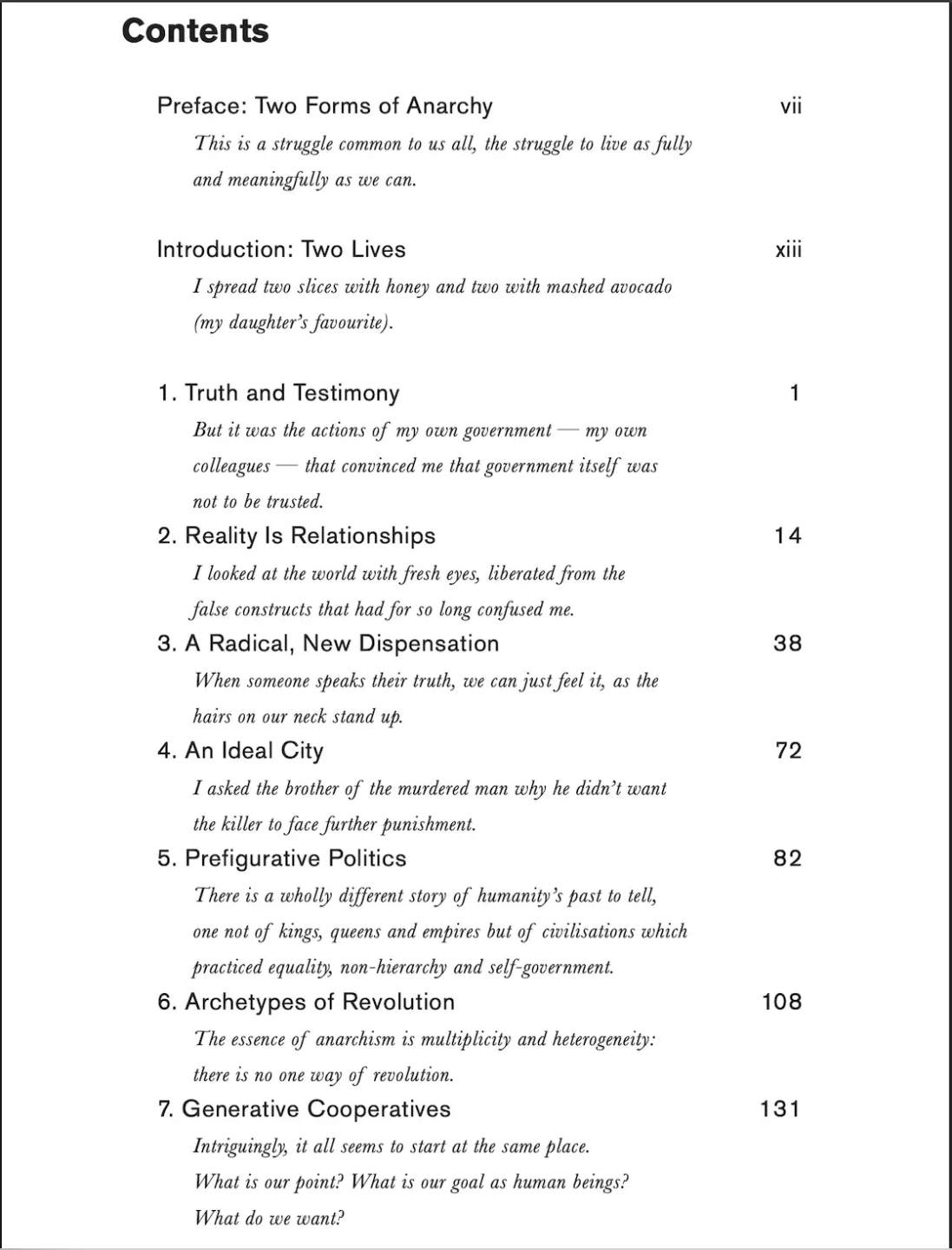
It was the actions of my own government – my own colleagues – that convinced me that government itself was not to be trusted.
I now ask myself if I didn’t partly become a diplomat because it was a ready-formed identity, into which I could enclose myself and, zipping myself up, be insulated from the vicissitudes of confronting actual human adult existence.
I had told the Foreign Office that I intended to study the empirical basis of policymaking. Little did they know, little did I know, that this would form my first steps towards anarchy.
Life shouldn’t be about the future. It should be good enough here and now.
Meanwhile, the power we have over the state is slightly greater than zero, but only slightly – a vote every five years. By contrast, the power the government has over us is absolute in almost every aspect of our lives. It’s an absurd and grotesque imbalance. This is what we call ‘democracy’.
Agency is at the heart of our well-being. We cannot enjoy a life of freedom and flourishing without it. As long as there is imposed authority, we are denied the ability to live as we wish or to negotiate our needs directly with other people. There is only one solution: give agency back. What this means is not less democracy, as the fascists threaten, but more.
That sense of inferiority and failure is a product of the system. Most of us feel that we have failed in some fundamental way. Notably, this is an individual mental feeling – we feel it alone. We do not share our shame.
There is a wholly different story of humanity’s past to tell, one not of kings, queens and empires but of civilisations which practised equality, non-hierarchy and self-government.
And here we find ourselves again, back to the same questions. Perhaps at our deepest level we are afraid of losing the religion of capitalism. If we don’t believe in that materialist and horribly logical belief system, what do we believe in?
These anarchists realised that asking others to effect change was futile. It had to come from oneself. And therein lay great liberation and joy.
The essence of anarchism is multiplicity and heterogeneity: there is no one way of revolution.
So the conclusion we’re left with is that the only way to de-centre growth as the ‘point’ of society and indeed government is to shift to a different kind of democracy where everyone is included, delivering different decisions about what matters – social solidarity, justice, provision of basic services to live.
It was a dispiriting exercise of wading through long, over-negotiated and tedious texts, dense with wordy reaffirmations of past agreements and light on actual decisions to do or change anything, and endlessly trying to pep up demoralised and overworked diplomats. Meanwhile, in the real world outside the negotiating chamber, Palestinians were being slaughtered in their tens of thousands in the Gaza Strip; Russian missiles rained down on Ukrainian cities.
I would eat entire packets of chocolate Hobnobs on my way back from the supermarket. I gained thirty pounds.

The attacks on the World Trade Center did indeed transport New Yorkers into a shared and very stark and present reality, where for once we were not individuals selfishly seeking our own goals, obsessing about our own lives, but we were experiencing something extraordinary together. A glib term for this might be ‘bonding experience’, but it was much more than that. It was something more which, of course, I am struggling to put into words. An intensity of being. Something that we could only experience in relationship to one another; it was created together, as we at last encountered ‘the real’. It was beautiful and sad, forged by the sharing of our all-too-tangible experience but also other worldly, ineffable, immeasurable, ethereal…essential. Strangely, I miss it now. I wonder why it took mass death to throw us into that limitless dimension.
As one marketing expert put it to me, people want to buy meaning. The trouble is, of course, that it cannot be bought.
It feels scary and decidedly unfashionable to use words of great ambition and aspiration. But I believe that something magnificent is available, if only we see it, if only we have the courage to build it. A world where we at last can find fulfilment, meaning and purpose, through the practice of intimate cooperation and mutual aid, an environment propitious for that most vital and epic of human needs, wants and joys – love itself, an act not just a feeling. I have no words adequate to convey its gravity or its qualities except to say that it is the most important thing of all.
updates
Sign up here for news about book signings, talks, online discussions, videos and other updates about Carne's work
"A luta continua, vitória é certa"